To apply for an Ex certificate, you shall go through a nationally recognized Ex certification body. The process includes key stages such as preliminary preparation, application submission, sample testing, document review, and certificate issuance. Below are the detailed steps and key points:
I. Preliminary Preparation and Consultation
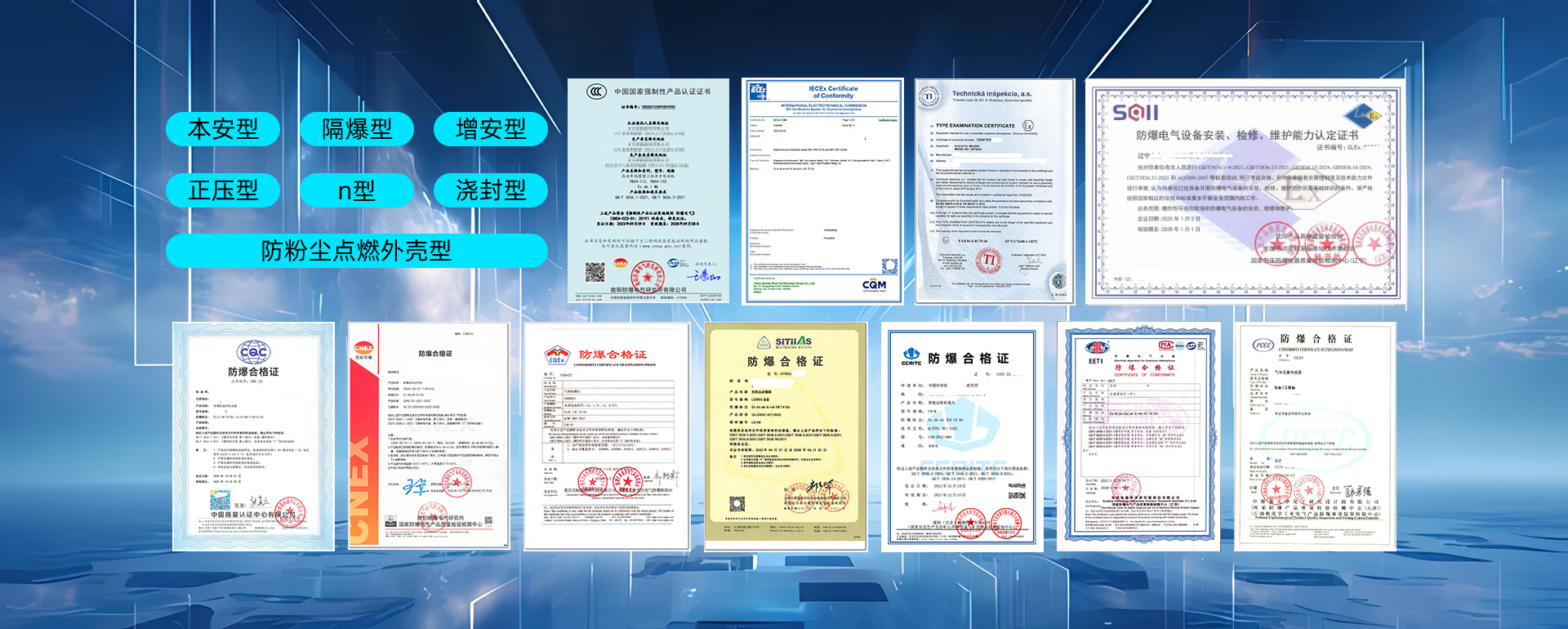
1. Determine the product’s operating environment and Ex type (e.g., intrinsically safe type, flameproof type, increased safety type, etc.), and refer to the latest national standards (e.g., GB/T 3836 series).
2. You may consult a professional agency (e.g., STS) for a preliminary evaluation.
II. Application Submission and Document Preparation
1. Submit the application to the certification body along with the following documents:
- Enterprise qualification documents: Business license and application form
- Product technical documents: Design drawings, user manual, and enterprise standards
2. Samples: The samples shall be consistent with the drawings, and the quantity shall be determined according to the Ex type (usually 1–2 units).
III. Sample Testing and Rectification
1. Submit the samples to a laboratory for testing, including structural inspection, temperature test, spark ignition test, high and low temperature resistance test, dielectric strength test, etc. If the test fails, the product shall be rectified and re-submitted for testing.
2. Document review and on-site inspection (if applicable)
IV. Certificate Issuance and Maintenance
Upon passing the review, the Ex certificate will be issued, specifying the product model, Ex rating, and validity period. The certificate is usually valid for a certain period (typically 5 years).
V. List of Required Documents and Materials
1. Enterprise qualification: Business license and application form
2. Product documents: Design drawings, user manual, enterprise standards, and list of key components
3. Samples and tools: Complete prototype machine, special disassembly and assembly tools (if required)
4. Other documents: Battery specifications, wireless transmission power report, potting process documents, etc.
VI. Certification Bodies and Notes
1. Certifying bodies: CQST, PCEC, CQC, Chongqing Coal Science Research Institute, Beijing Coal Science Research Institute, Suzhou Electrical Apparatus Science Research Institute, etc.
2. Authorized agencies: STS
3. Time and cost: The certification cycle ranges from several weeks to months, and the cost varies depending on product complexity.
VII. Key Points for Ex Certification
1. Select a qualified certifying body and an experienced authorized agency (e.g., STS).
2. Ensure the product design complies with relevant standards to avoid delays caused by rectification.
3. Maintain production consistency during the validity period of the certificate.
證.jpg)
.jpg)
目 - 2021-11-09T091045 (2).jpg)
.jpg)
.jpg)

 |
||||||
 |
||||||
|
||||||
 |
||||||
|
||||||
 |